On July 13, 2026, the U.S. Chamber of Commerce — joined by the American Tort Reform Association and the American Property Casualty Insurance Association — filed an amicus brief in the U.S. Court of Appeals for the Eleventh Circuit urging the court to vacate the $243 million verdict entered against Tesla, Inc. in the Benavides Autopilot case. The amici argue, in substance, that verdicts of this kind chill innovation and deter manufacturers from bringing new technology to market.
We think that argument deserves a hard look — and that it proves less than the business groups suggest.
What the Jury Actually Found
The case arises from an April 25, 2019 collision at a T-intersection on Card Sound Road in Key Largo, Florida. George McGee was operating a Tesla Model S with Autopilot engaged. He dropped his cellphone, reached down to retrieve it, and the vehicle traveled through a stop sign and a flashing red light at roughly 62 miles per hour, striking a parked SUV. Naibel Benavides Leon, 20 years old, was killed. Her boyfriend, Dillon Angulo, was catastrophically injured. Both were standing beside the parked vehicle.
After a trial last August, an eight-person federal jury in Miami returned a verdict that is more nuanced than the headline number suggests:
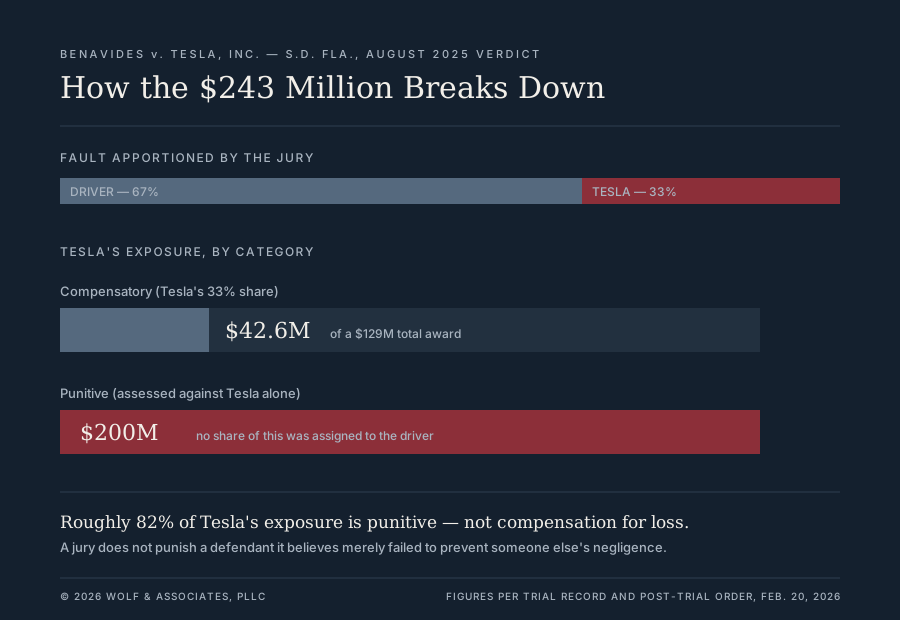
- Comparative fault. The jury apportioned roughly 67% of the fault to the driver and one-third to Tesla.
- Compensatory damages. The jury awarded $129 million in compensatory damages. Tesla's proportionate share of that figure is approximately $42.6 million.
- Punitive damages. The jury separately assessed $200 million in punitive damages against Tesla alone.
Tesla's total exposure — approximately $243 million — is therefore overwhelmingly punitive, not compensatory. That distinction is the entire ballgame on appeal, and it is worth keeping in view whenever the $243 million figure is invoked as though it were a measure of the plaintiffs' losses.
© 2026 Wolf & Associates, PLLC
On February 20, 2026, U.S. District Judge Beth Bloom denied Tesla's post-trial motions for judgment as a matter of law and for a new trial, finding the trial record sufficient to support the jury's findings. The appeal to the Eleventh Circuit followed.
The Amici's Argument — and Its Weak Point
The business coalition's position, as reported, is that a verdict like this one effectively demands that manufacturers design products that cannot be misused, and that such a standard will deter the development of beneficial technology.
That framing does not fit the facts the jury found.
The jury did not hold Tesla responsible for the driver's negligence. It expressly assigned that negligence to the driver, and assigned two-thirds of it. What the jury found — and what the punitive award reflects — is something different: a conclusion that Tesla's own conduct, in how it designed, marketed, and represented a driver-assistance system, was independently culpable. A defendant found only one-third at fault on compensatory damages does not draw a $200 million punitive award because a jury was confused about who ran the stop sign. It draws that award because the jury concluded the company's conduct warranted punishment.
"Foreseeable misuse" is also doing a great deal of work in the amici's framing. In products liability, foreseeable misuse is not a defense — it is a design consideration. A manufacturer that markets a system under a name like "Autopilot," and that knows drivers will over-rely on it, cannot then characterize that over-reliance as an unforeseeable intervening act. The entire body of design-defect law asks whether a manufacturer accounted for how its product would actually be used in the real world, not how it would be used by a hypothetical ideal consumer.
Why This Matters Beyond Tesla
There is a real and legitimate question in this appeal, and it is not the one the Chamber is pressing. It is whether a $200 million punitive award, imposed on a defendant the same jury found 33% at fault, is constitutionally excessive under BMW of North America v. Gore and State Farm v. Campbell. Reasonable lawyers can disagree about the answer. Tesla has reportedly argued that a proper application of punitive-damages limits could reduce its total exposure to roughly $172 million. That is an argument about proportionality, and appellate courts entertain it seriously.
But that is not the argument the amici are making. They are making a policy argument — that liability itself is the problem — and asking a federal appellate court to adopt it as a rule of decision.
We would suggest the opposite lesson. The civil jury is one of the few mechanisms in American law capable of imposing a real cost on a company that markets a safety-critical technology more aggressively than the technology's actual capabilities warrant. Regulators move slowly. Recalls come late. A jury verdict is often the first moment a manufacturer confronts a genuine financial consequence for a design or marketing decision it made years earlier.
If autonomous and semi-autonomous vehicle technology is going to be deployed on public roads — and it is — then the companies deploying it should bear the cost of the harm it causes when they get it wrong. That is not a threat to innovation. That is the price of it.
What Comes Next
The Eleventh Circuit will now receive briefing from Tesla, from the plaintiffs, and from the amici on both sides. A decision is unlikely before 2027. Whatever the outcome, this case will shape how courts nationwide approach the allocation of responsibility between a negligent operator and the manufacturer of the system that operator was trusting.