On October 15, 2026, the Superior Court of Pennsylvania affirmed a judgment of nearly $816 million in favor of Paul Gill, a former service-station mechanic who developed acute myeloid leukemia decades after working with benzene-containing gasoline and solvents. ExxonMobil asked the appellate court to undo the award. The court refused — leaving intact what the plaintiff's trial team has described as the largest benzene verdict on record.
For anyone who has ever earned a living with gasoline, solvents, or degreasers on their hands, this case is worth understanding in some detail.
Five Years at the Pumps, a Diagnosis Forty Years Later
In the mid-to-late 1970s, Paul Gill worked as a mechanic and attendant at a Mobil service station. Like countless mechanics of that era, he testified that he used gasoline and petroleum solvents every working day — washing car parts in them, often with his bare hands, breathing the vapors in an enclosed garage. Nobody told him that the benzene in those products was a known cause of blood cancer.
In 2019 — roughly four decades after he left the station — Mr. Gill was diagnosed with acute myeloid leukemia, a cancer long associated with benzene exposure. He and his wife, Diane, sued ExxonMobil in Philadelphia, contending that the company knew of benzene’s dangers and failed to warn the workers who handled its products.
The procedural history since then has been remarkable:
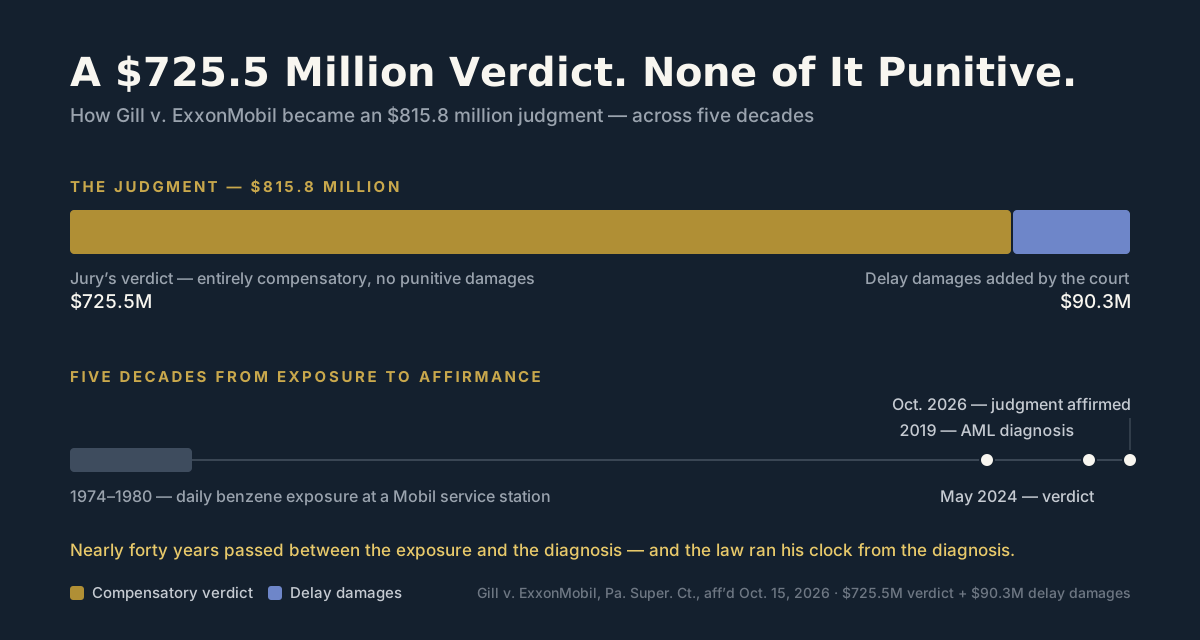
- May 2024. After trial, a Philadelphia jury returned a 10–2 verdict against ExxonMobil for $725.5 million — reported by the plaintiff’s counsel to be entirely compensatory damages, with no punitive component.
- September 2024. The trial court denied ExxonMobil’s post-trial motions — the company had called the verdict “irrational” — and added roughly $90 million in delay damages under Pennsylvania procedure, bringing the judgment to approximately $815.8 million.
- October 15, 2026. The Superior Court of Pennsylvania affirmed. As reported, the panel held that ExxonMobil had waived most of its appellate arguments by failing to preserve them at trial, and rejected its remaining challenges to the medical-causation evidence and to the size of the award, including a due-process attack on the compensatory verdict.
© 2026 Wolf & Associates, PLLC
Why the Affirmance Matters
First, the latency. Mr. Gill’s exposure ended around 1980. His diagnosis came in 2019. Toxic-exposure cases live or die on this point: the law in most states, New York and New Jersey included, generally measures the filing deadline from the discovery of the injury and its cause — not from the exposure itself. A worker poisoned in the 1970s whose cancer surfaces today may still have a claim. Most people assume the opposite, and that assumption costs families their rights every year.
Second, the theory. This was a failure-to-warn case. The jury was not asked to find that gasoline is defective; it was asked whether a company that knew benzene causes leukemia owed the people handling its products a warning, and failed to give one. That is the same legal architecture that supports claims for other toxic products — solvents, degreasers, industrial chemicals, contaminated equipment — and it is why the verdict resonates far beyond one gas station.
Third, the number is compensation, not punishment. By the trial team’s account, the $725.5 million contained no punitive damages at all. A jury of twelve Philadelphians listened to the evidence of what acute myeloid leukemia did to this man and his wife and put that figure on the harm itself. Appellate courts give substantial deference to a jury’s valuation of human suffering, and the Superior Court’s refusal to disturb it underscores the point.
Fourth, the waiver lesson. The reported basis for much of the ruling — that ExxonMobil failed to preserve its arguments at trial — is a reminder that these cases are won in the trial court, objection by objection, witness by witness. Even a defendant with unlimited resources cannot build a new case on appeal.
Who Should Pay Attention
Benzene is not an exotic chemical. For decades it was in the gasoline at every pump, in parts-washing solvents, in printing-industry fluids, in rubber and chemical plants, aboard ships and in refineries. The workers most heavily exposed were mechanics, gas-station attendants, printers, painters, refinery and plant workers, and the tradespeople who cleaned up after all of them.
The diseases linked to benzene exposure include acute myeloid leukemia (AML), myelodysplastic syndromes (MDS), and other cancers of the blood and bone marrow. Because these diseases surface decades after exposure, the person diagnosed is often retired — and often has no idea the two events are connected. The Gill case is a nearly billion-dollar demonstration that the connection is real, provable, and compensable.
What Comes Next
ExxonMobil may ask the Pennsylvania Supreme Court to take the case; that review is discretionary, and the state’s highest court accepts only a small fraction of the petitions it receives. Unless and until a further court intervenes, the judgment stands — and with post-judgment interest accruing, its value only grows.