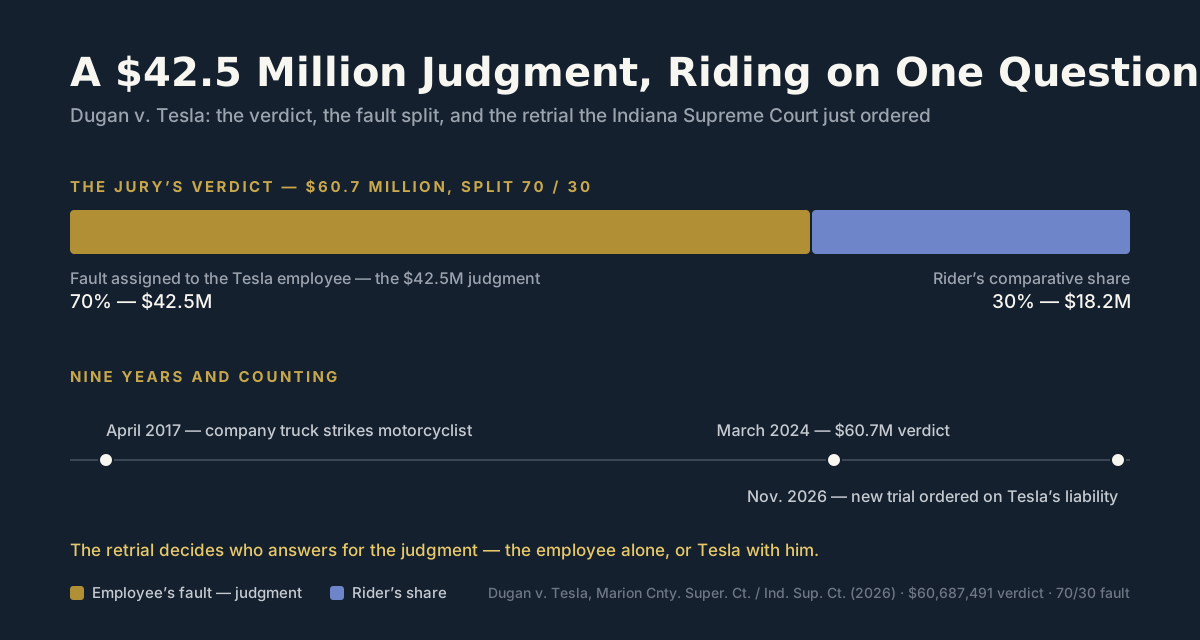
The Indiana Supreme Court has ordered a new trial on whether Tesla can be held responsible for a devastating motorcycle crash caused by one of its employees driving a company truck. The court did not erase the verdict against the driver, and it did not say Tesla is off the hook. It said something narrower — and, for anyone hurt by a driver in a company vehicle, far more instructive: whether the employee was acting in the scope of his employment is a question for a jury.
Nine years after the crash, the single question that decides who actually pays a $42.5 million judgment is going back to a jury box.
A Company Truck, a Left Turn, a Shattered Life
In April 2017, Christopher Dugan was riding his motorcycle near Indianapolis when a Tesla service employee, driving a Tesla-owned Ford F-250 service truck, turned left across the oncoming lanes and struck him. As reported, Mr. Dugan — a father from Avon, Indiana — suffered a severe and permanent traumatic brain injury and a partial foot amputation. He lives today with profound cognitive impairment; his case has been pursued by a guardian on his behalf.
In March 2024, after Tesla reportedly declined to offer a settlement, a Marion County jury returned a verdict of $60.7 million. The jury assigned 70% of the fault to the Tesla employee and 30% to Mr. Dugan — producing a judgment of roughly $42.5 million.
© 2026 Wolf & Associates, PLLC
The Question That Decides Who Pays
The employee’s negligence was one fight. The other — the one worth tens of millions — is respondeat superior: the doctrine that makes an employer answer for what its employee does within the scope of employment.
Tesla’s position leaned on the “going and coming” rule — the principle that an employee merely commuting to or from work is generally not on company business. The injured rider’s side pointed at everything that made this no ordinary commute: a company-owned service truck, and reporting that the employee was fueling or transporting the vehicle consistent with company practice. The trial court resolved that question in the plaintiff’s favor without a trial.
On November 5, 2026, the Indiana Supreme Court held that was a step too far: where the facts about an employee’s errand cut both ways, a jury — not a judge — must decide scope of employment. The case now returns for a new trial on Tesla’s vicarious liability.
Why This Ruling Matters to Injured People
First, the money is usually in the employer’s policy. A judgment against an individual driver is often worth only what his personal coverage will pay. A judgment against the company behind the truck reaches commercial policies sized for the company’s risk. In catastrophic-injury cases, scope of employment is not a technicality — it is frequently the difference between a paper judgment and a real recovery.
Second, these cases are won with evidence gathered early. Who owned the vehicle. What the driver was doing, for whom, on whose clock. Dispatch records, fuel cards, schedules, texts with supervisors, written and unwritten policies about taking the truck home. That is exactly the record this retrial will be fought on — and it is the record we move to preserve in the first weeks of every company-vehicle case we handle.
Third, the sword cuts both ways — and that’s fair. Plaintiffs usually want juries, not judges, deciding fact questions. A rule that says “scope of employment belongs to the jury” will sometimes undo a plaintiff’s shortcut, as it did here. But in the long run it is the rule that lets injured people put an employer’s real-world practices in front of twelve citizens instead of losing on a motion.
Fourth, the verdict against the driver stands apart. The new trial concerns Tesla’s responsibility. The jury’s findings about the crash itself — a company service truck turning across traffic into a motorcyclist — have already been made once, at full volume.
The Same Fight Happens in New York and New Jersey
Delivery vans, service trucks, livery vehicles, contractors’ pickups — our region’s roads are full of employees driving for someone else’s benefit. New York and New Jersey apply the same core doctrines: an employer answers for an employee’s negligence within the scope of employment, commuting is generally outside it, and the gray zone in between — errands, detours, employer-provided vehicles taken home — is where these cases are won and lost. If a company vehicle hit you, which side of that line the driver was on may matter more than anything else in your case.
What Comes Next
The case returns to the trial court, where a jury will decide whether the employee was on Tesla’s business when he made that left turn. If it finds he was, Tesla stands behind the judgment. Nine years in, the family’s fight continues — a reminder that catastrophic-injury litigation is a marathon, and that the lawyers who build the scope-of-employment record on day one are the ones still standing at the finish.